

How to Evaluate CRM Customisation Experts in Brisbane
Microsoft Dynamics 365 can become difficult to use when its default fields, stages, and reporting no longer reflect how your teams work. CRM customisation experts in Brisbane can help assess whether the problem needs configuration, integration, process redesign, or a broader implementation plan.
The right partner starts with business process discovery. They should identify where staff re-enter data, rely on spreadsheets, miss handovers, or cannot trust reports before recommending changes.
Key Takeaways for Evaluating Brisbane Specialists
- Look for recurring manual work, unreliable reporting, disconnected systems, poor user adoption, and rising change requests.
- Ask how the consultant will map workflows before proposing fields, automations, or integrations.
- Confirm how they will protect data quality, security roles, audit history, and existing technology investments.
- Prefer phased delivery with clear priorities, user testing, training, and support after go-live.
- Check that licensing, tenant configuration, and third-party connector requirements are considered early.
BeyondCRM works with internal IT teams and other technology providers to connect Microsoft Dynamics 365 with systems already in use. The goal is to improve the operating model, not assume every existing system needs replacing.
I’m Warren Davies, Founder of BeyondCRM. With more than 30 years of Microsoft Dynamics CRM and Power Platform consulting experience, I help organisations assess CRM design decisions in practical terms, from workflow mapping and integration choices to user adoption and ongoing support.
5 Signs You Need CRM Customisation Experts in Brisbane
You may need specialist CRM support when the system creates extra administration, weakens reporting confidence, or prevents teams from following a consistent process. The most useful warning signs are operational, not technical.
1. Staff rely on spreadsheets or side systems
A CRM should give teams one dependable place to manage customer, service, and operational information. If staff copy information into spreadsheets, shared inboxes, or separate trackers, the underlying data model or workflow may no longer fit the job.
A specialist can identify whether a new table, form, validation rule, integration, or simpler process would reduce duplicate entry. The answer is not always more customisation. Sometimes removing unnecessary fields is the better fix.
2. Reports do not answer management questions
Leaders need reporting that reflects agreed definitions and current records. If teams debate which report is correct, export data for manual reconciliation, or cannot see the status of a handover, the CRM may lack consistent stages, ownership rules, or required data.
CRM customisation experts can trace a report back to its source fields and process steps. This helps determine whether the issue is missing data, inconsistent use, security access, or reporting design.
3. Existing systems do not share the information teams need
Disconnected systems often create delays between customer activity, documents, service work, finance milestones, and internal follow-up. Depending on licensing, tenant configuration, and connector availability, Dynamics 365 may integrate with Microsoft 365, SharePoint, telephony, finance platforms, or internal applications.
The important question is which information must move between systems, who owns it, and when it should update. CRM customisation services should begin with that operational requirement rather than a preferred tool.
4. Users avoid the CRM or enter incomplete records
Low adoption is often a design signal. Long forms, irrelevant fields, unclear ownership, and workflows that add no visible value can encourage incomplete records and inconsistent follow-up.
A practical review considers each user role separately. It may simplify forms, create role-based views, set proportionate mandatory fields, and provide training around the real tasks staff perform.
5. Every business change becomes a slow, risky request
A growing organisation will change approval paths, services, reporting needs, and customer handovers. If a small change routinely creates confusion or breaks another process, the CRM may need clearer architecture, governed change control, and supported configuration.
This is where experienced design matters. A well-scoped solution should make routine changes easier to assess while keeping security, integrations, and data quality under control.
What CRM Customisation Experts Should Assess Before Changing Dynamics 365
A credible consultant should understand the business process and technical environment before changing Dynamics 365. That assessment prevents organisations from paying for features that do not solve the real operational issue.
Configuration, customisation, and integration are different decisions
Configuration uses standard platform options such as forms, views, business process flows, security roles, and reporting settings. Customisation may add tailored tables, logic, or user experiences. Integration connects Dynamics 365 with other systems where the business needs controlled information exchange.
These approaches have different costs, risks, and maintenance needs. Supported configuration is often easier to maintain, while tailored development may be justified for a unique operational requirement that cannot be met through standard capabilities.
A detailed Dynamics 365 customisation guide can help stakeholders understand these choices before approving a project.
Data, security, and compliance need to be designed together
Customisation should protect record quality as well as make screens easier to use. Consultants should consider who can create, view, change, or export data, how audit history is required, and which fields need validation.
Role-based security, field security, audit settings, and retention decisions depend on the organisation’s tenant, licensing, implementation design, and governance obligations. These controls can support the Australian Privacy Principles and internal audit requirements, but they do not replace legal or compliance advice.
Integration planning should start with a data flow
Before connecting systems, define the business event that triggers the exchange. For example, a customer record may need an approved identifier, a clear system of record, and an exception process before information is shared.
Where configured appropriately, Dynamics 365 can help users track and link relevant Microsoft 365 emails, SharePoint documents, and Teams collaboration to business records. Other connections may need additional modules, third-party connectors, or custom integration work. A specialist should explain those dependencies before delivery begins.
Human review still matters. Rules can support routing and reminders, but staff must remain accountable for customer qualification, exceptions, and follow-up.
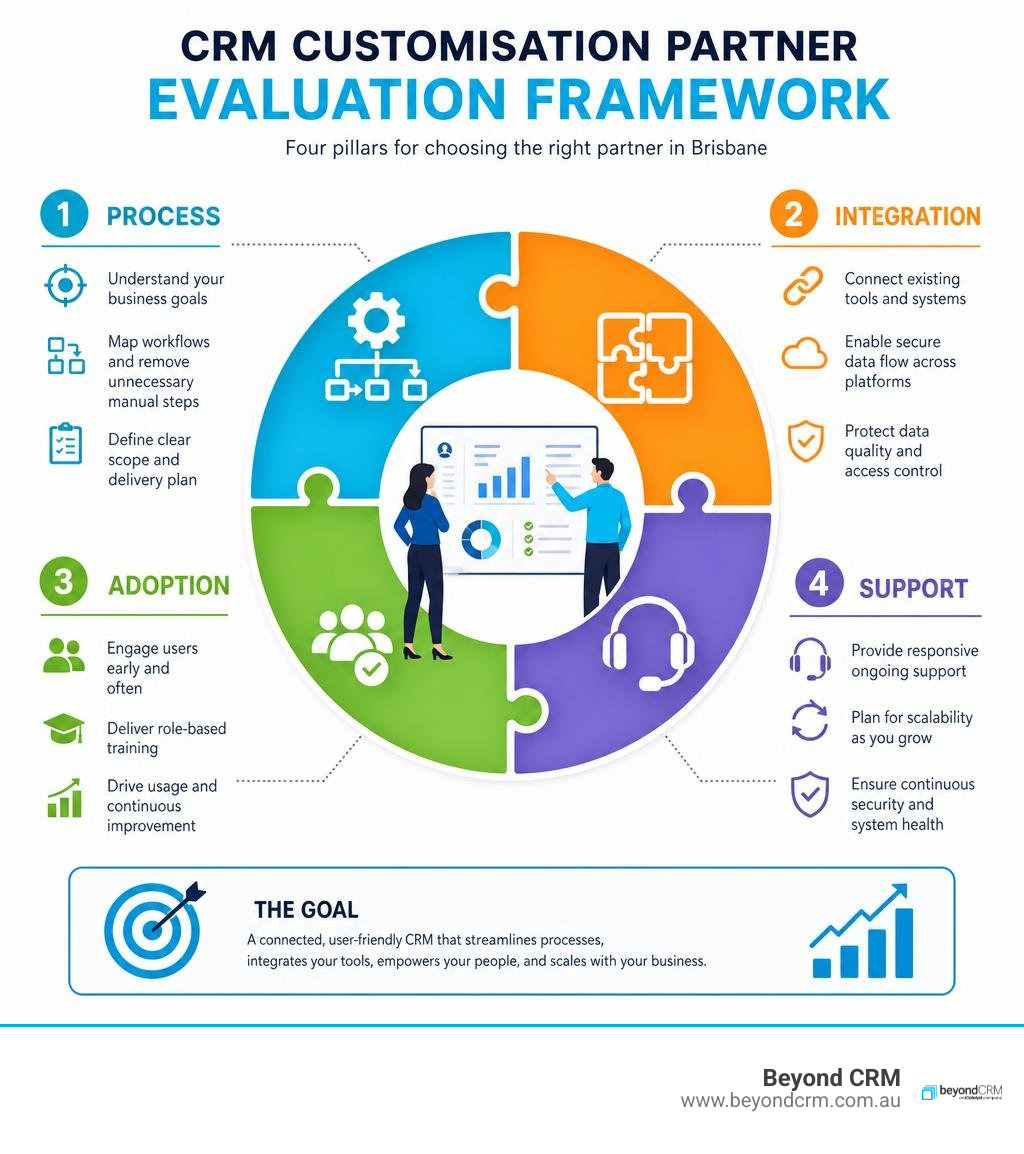
How to Choose the Right CRM Customisation Partner in Brisbane
The right CRM partner combines business analysis, platform knowledge, and disciplined delivery. Local availability can help with workshops and stakeholder engagement, but the quality of discovery and governance matters more than postcode alone.
Ask how the consultant will discover the real problem
A useful first workshop maps the current process from trigger to outcome. It should identify handovers, approvals, duplicate entry, reporting needs, exception handling, and the systems involved.
Ask the consultant to explain what they would measure before recommending a solution. Strong answers distinguish between a people, process, data, integration, and platform-design issue.
Check the proposed delivery approach
For complex environments, phased delivery reduces risk. A sensible plan usually starts with priority workflows and data foundations, then moves to integrations, refined reporting, and additional functionality after users have tested the core process.
Each phase should define scope, responsibilities, acceptance criteria, training needs, and a change-control process. This reduces the chance that urgent requests create conflicting fields, duplicate rules, or fragile custom code.
Evaluate long-term support, not only implementation
Ask who will document the solution, train administrators, monitor issues, and assess future requests. A partner should be comfortable working alongside internal IT teams and external providers when Dynamics 365 is one part of a broader technology environment.
Look for clear explanations of licensing assumptions, security responsibilities, support response arrangements, and any third-party dependencies. Those details help decision-makers compare proposals on long-term maintainability, not only initial scope.
CRM Customisation Experts Brisbane: Frequently Asked Questions
CRM customisation experts in Brisbane help organisations decide whether Dynamics 365 needs configuration changes, tailored design, integrations, training, or a staged improvement plan.
What is the difference between CRM configuration and customisation?
Configuration uses standard Dynamics 365 options, such as forms, views, security roles, and business process flows. Customisation adds tailored data structures, logic, or interfaces when the standard platform cannot meet a genuine operational requirement. The right choice depends on maintainability, licensing, governance, and the value of the outcome.
When should a business bring in a CRM consultant?
Bring in a consultant when teams rely on manual workarounds, reporting is unreliable, important systems are disconnected, user adoption is falling, or a proposed change affects several teams. An early review can clarify the problem before a business commits to development work.
How long does a CRM customisation project take?
Timing depends on the number of workflows, data quality, integration scope, stakeholder availability, testing requirements, and approval processes. A focused improvement may be delivered in stages, while an enterprise-wide programme can require a longer discovery and rollout period. A credible proposal should explain the assumptions behind its timeline.
Can Dynamics 365 integrate with Microsoft 365 and other business systems?
It can often integrate with Microsoft 365 services and other platforms, subject to licensing, tenant configuration, security settings, connector availability, and implementation design. Some requirements need third-party connectors or custom integration work. Confirm the required data flow and ownership before choosing an approach.
How do CRM specialists improve user adoption?
They start by learning how each role uses the system. Improvements may include simpler forms, clearer stages, role-based views, useful training, and a process for collecting feedback after go-live. Adoption improves when the system reduces a real task burden rather than adding another administrative step.
What should be included in a CRM customisation proposal?
A proposal should state the business outcomes, in-scope processes, assumptions, integrations, data migration work, licensing considerations, security responsibilities, acceptance criteria, training, support, and change-control approach. It should also identify what is excluded so stakeholders can make an informed comparison.
Choosing CRM Customisation Experts in Brisbane

CRM customisation is worthwhile when it makes daily work clearer, reduces duplicate handling, and gives leaders more dependable information for decisions. Start by defining the operational problem, then compare partners on discovery quality, design discipline, integration planning, user adoption, and ongoing support.
BeyondCRM supports large enterprises, government organisations, and complex business environments with Microsoft Dynamics 365 consulting, design, integration, customisation, training, and ongoing support. We work with existing IT providers where appropriate, so a CRM programme can strengthen the wider technology environment rather than force unnecessary replacement.


