

Data Migration Strategies Start With a Clear Plan
Microsoft Dynamics 365 data migration strategies succeed when organisations define clear scope, data mapping rules, validation criteria, and cutover windows before execution. A structured plan prevents operational disruption and preserves data integrity across every department.
Effective planning reduces delivery risks during complex platform transitions. Consider these essential takeaways:
- Choose an appropriate cutover method based on downtime tolerance and architectural complexity.
- Profile and cleanse source data early to prevent loading invalid records into destination entities.
- Validate field mappings and lookup relationships using representative sample records.
- Establish automated reconciliation checks to verify record counts and field values.
- Maintain legacy system access until operational teams complete formal validation testing.
I’m Warren Davies, Founder of BeyondCRM, with over 30 years of CRM consulting experience across Microsoft Dynamics CRM, large enterprises, government organisations, and complex business environments. I help organisations plan practical data migration strategies that connect Microsoft Dynamics 365 with existing systems, working alongside other IT providers where needed.
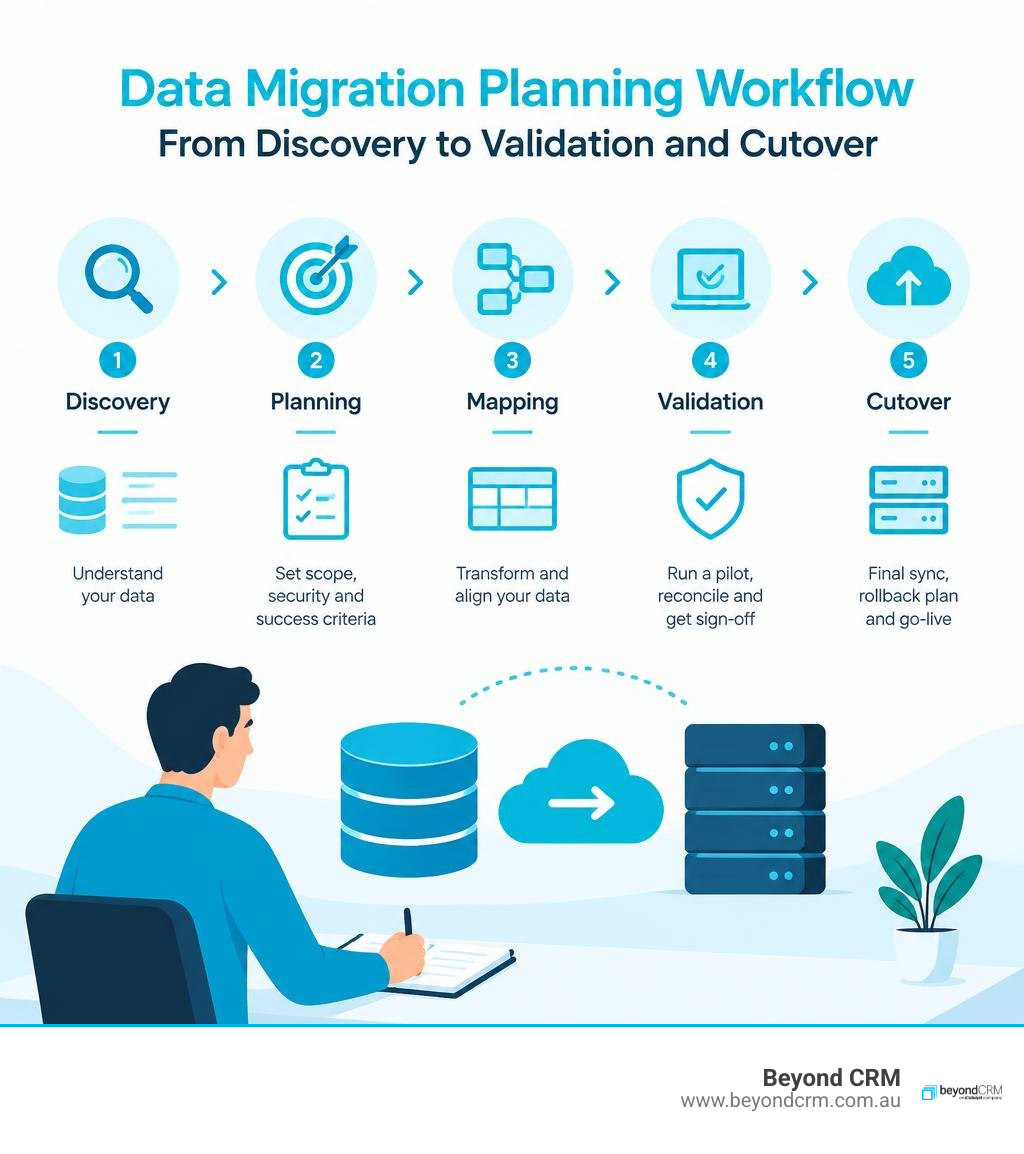
Core Data Migration Strategies and Architectural Approaches
Selecting the right data migration approach requires balancing business downtime tolerance, technical complexity, cost, and operational risk. Core architectural models define how data moves from legacy databases to modern cloud platforms.
Evaluating your core architectural model early helps prevent costly rework later. Establishing a structured strategy allows technical and operational teams to align on cutover timelines.
Key migration approaches include:
- Big Bang: Executes full cutover during a single planned outage window. Best suited for smaller data volumes and non-critical weekend maintenance windows.
- Phased (Trickle): Moves datasets in structured stages by business unit or entity. Reduces operational risk for complex relational schemas.
- Parallel Run: Operates source and target platforms concurrently with dual synchronisation. Provides continuous fallback for mission-critical operations.
- Lift-and-Shift: Rehosts databases to cloud infrastructure with minimal schema changes. Accelerates infrastructure exits when refactoring is not immediately required.
Evaluating Common Data Migration Strategies for Enterprise Systems
The big bang migration moves all datasets from the source to the target environment within a single operational window. While this eliminates running dual platforms, it requires sufficient downtime to extract, transform, load, and validate records.
A phased migration transfers data in structured increments categorised by business unit, entity module, or timeframe. This approach confines potential issues to specific workloads while keeping critical operations running.
The parallel run strategy maintains active production operations on both source and target platforms concurrently. Data replicates between systems, allowing end users to compare transactional outputs before decommissioning legacy infrastructure.
Selecting Data Migration Strategies for Heterogeneous Database Platforms
Database migrations fall into two primary classifications: homogeneous and heterogeneous. Homogeneous migrations move data between identical database engines, such as moving an on-premises Microsoft SQL Server instance to a managed cloud database.
Heterogeneous migrations involve moving data between different database engines, such as moving legacy proprietary databases to modern cloud targets. These projects require structural refactoring.
The 7 Rs framework helps technology leaders determine the right modernisation path. Categorising workloads through systematic assessment identifies schema incompatibilities and data type mismatches well before execution.
Technical Schema Conversion and Execution Tooling

Technical schema conversion converts legacy database definitions, stored procedures, and programmatic logic to align with target platform syntax. Modern conversion tools automate dialect translation and reduce manual refactoring errors.
Adhering to structured migration practices ensures business rules, lookup relationships, and foreign key hierarchies transfer accurately into Microsoft Dynamics 365.
Tooling updates have expanded platform interoperability across diverse database engines. Modern utilities parse database metadata, convert table definitions, and translate stored routines to match target analytical environments.
Resolving Schema, Stored Procedure, and Data Type Incompatibilities
Heterogeneous database engines handle procedural syntax, system functions, and data types differently. A common obstacle involves proprietary procedural code such as stored procedures, triggers, and views.
Modern schema conversion capabilities help resolve these engine-specific barriers:
- MERGE Statement Conversion: Automated utilities convert complex MERGE statements into native syntax supported by modern database versions.
- Relational Operator Handling: Automated translation supports PIVOT and UNPIVOT relational operators when migrating legacy data warehouses to cloud targets.
- ETL Package Modernisation: Legacy ETL assets transform into managed cloud execution graphs and serverless state machines via automated scripts.
- Pipeline Script Parsing: Command-line parsing of legacy ETL workflows facilitates script conversion and pipeline restructuring.
Recognising and resolving programmatic differences early prevents downstream corruption during complex enterprise system replacements.
Optimising Extraction Agents and High-Volume Workloads
Large analytical databases require high-throughput data extraction agents to pull records without degrading active source performance. Extraction agents read data from source tables and write staging files directly to cloud storage.
Modern extraction tooling incorporates automated memory balancing across worker agents to prevent memory exceptions during batch transfers. Extraction agents leverage native database structures:
- System-Column Virtual Partitioning: Extracting large datasets can use system attributes to parallelise thread extraction without table locks.
- Physical Block Slicing: Migrating high-volume tables uses physical block ranges to partition data into balanced, concurrent extraction chunks.
- Multiserver Discovery: Comprehensive assessment reports scan diverse environments to generate uniform complexity scores and refactoring roadmaps prior to migration.
End-to-End Migration Planning, Data Integrity, and Security

Enterprise data migrations require structured governance, strong encryption, and methodical validation to protect business assets during transition. Verified testing runbooks ensure systems remain secure and functional before cutover.
Data profiling identifies missing mandatory attributes, invalid formatting, orphan foreign keys, and duplicate entity records within legacy systems. Cleansing data in the source environment avoids loading invalid values into destination schemas.
Enforcing Governance, Authentication, and Encryption Standards
Protecting data in transit and at rest is a non-negotiable requirement. Data leaving enterprise perimeters must use TLS encryption, with resting data secured using customer-managed encryption keys.
Enterprise security configurations require strict authentication controls:
- Centralised Secret Management: Modern extraction pipelines integrate directly with credential brokers to eliminate hardcoded credentials from configuration files.
- Enterprise Identity Providers: Support for Kerberos authentication protocols across legacy sources maintains centralized access control auditing.
- Hardened Network Infrastructure: Migration agents operate on hardened operating systems supporting modern network protocols for enterprise connectivity.
- Regulatory Governance: Regulated industries must log extraction and load access to maintain continuous auditability throughout the transition.
For organisations managing customer information, configuring secure protocols ensures personal identifiers and sensitive commercial records remain protected during transformation.
Cutover Orchestration, Business Validation, and Rollback Procedures
The final cutover phase transitions operational workloads from the source system to the target platform. Successful orchestration relies on clear go/no-go criteria and rehearsed operational runbooks.
A standard production cutover process includes:
- Source System Freeze: Transition the legacy database into read-only mode to prevent new transactions during final delta extraction.
- Delta Synchronisation: Execute the final Change Data Capture batch to bring target data into parity with the source system.
- Automated Data Validation: Run automated validation scripts to check row counts, checksums, and relational key links across entities.
- User Acceptance Testing: Key business stakeholders execute predefined transactional tests to confirm workflows and integrations operate as expected.
- Go/No-Go Decision Point: Project sponsors review test results against documented acceptance criteria to formally approve cutover.
- Network Cutover and Hypercare: Switch DNS routing and API endpoints, initiating dedicated post-go-live support to monitor performance.
- Rollback Contingency: If critical defects emerge, initiate documented rollback steps to restore production traffic to the source platform.
Frequently Asked Questions About Data Migration Strategies
Understanding common migration challenges helps leadership teams evaluate architectural approaches, manage cutover risks, and avoid data loss. Below are answers to frequent technical and strategic questions.
How do organisations choose between big bang and phased migration?
Organisations evaluate three core criteria when choosing an approach: downtime tolerance, dataset volume, and system coupling. Big bang migrations suit organisations that can execute a complete system freeze over a non-operational window with lower data volume.
Phased migrations suit complex, high-transaction systems where extended outages are unacceptable. This method allows distinct departments or data modules to move independently with lower operational risk.
How do automated tools handle complex schema conversion and stored procedures?
Automated conversion utilities parse the source database data definition language and procedural code into an abstract syntax tree. The tool analyses this syntax against the target database dialect, automatically translating matching functions and table definitions.
Where target incompatibilities exist, the tool generates an assessment report. This report flags unconverted code items, categorises the estimated refactoring effort, and provides guidance for manual remediation.
What steps ensure zero data loss during high-volume database cutover?
Preventing data loss requires continuous replication using log-based Change Data Capture. During initial full-table loads, the migration tool records transactional log events in a staging buffer.
Once initial tables populate, the system applies buffered transactions to keep the target synchronised. Automated checksum scripts mathematically verify record counts and values before production traffic switches over.
Master Your Data Migration Strategies with BeyondCRM
BeyondCRM delivers structured data migration consulting and custom CRM design to ensure legacy records transfer safely into Microsoft Dynamics 365. We collaborate with internal IT teams and technology partners to protect business continuity.
Executing a dependable data migration strategy transforms legacy systems into modern platforms that support scalable reporting and operational efficiency. Moving enterprise data requires disciplined discovery, accurate schema mapping, rigorous reconciliation testing, and controlled cutover governance.
From over 30 years of CRM experience, Founder Warren Davies leads our consulting practice to help organisations migrate critical data into Microsoft Dynamics 365. Depending on your licensing model, tenant architecture, and integration design, we ensure your data structures and security roles align with operational requirements.


