

What Is CRM Alignment?
CRM alignment is the process of bringing sales, marketing, service, and other customer-facing teams together around shared customer data, lifecycle stages, ownership rules, and performance measures. In practice, each team can see the same account context, knows when responsibility changes hands, and records important updates in the same place.
That matters because customers experience one business, not separate departments. When qualification criteria, opportunity stages, and service handovers differ between teams, leads can be duplicated, follow-up can slow down, and leaders lose confidence in forecasts. A well-designed CRM provides the shared workflow and record structure needed to prevent those gaps.
For complex organisations, Microsoft Dynamics 365 can act as the central customer platform while connecting to existing finance, service, marketing, and reporting tools. The exact capabilities depend on licensing, tenant configuration, integration design, security settings, and the services in use, but the practical objective remains the same: make customer work easier to coordinate.
BeyondCRM helps large enterprises, government organisations, and other complex teams design, customise, automate, and support Dynamics 365 CRM environments alongside their existing IT solution providers.
I’m Warren Davies, Founder of BeyondCRM. I have spent more than three decades consulting on Microsoft Dynamics CRM and the Power Platform. In my experience, CRM alignment succeeds when teams agree on practical ways of working before asking technology to enforce them.
Key Takeaways
- CRM alignment gives sales, marketing, service, and operations a shared view of the customer journey.
- Clear lifecycle stages and handover owners reduce missed follow-ups and duplicated work.
- Sales and marketing alignment starts with shared qualification criteria and visible feedback loops.
- A CRM should connect only the systems that supply or need reliable customer information.
- Progress is measured through data quality, handover speed, stage conversion, forecast accuracy, and customer retention.
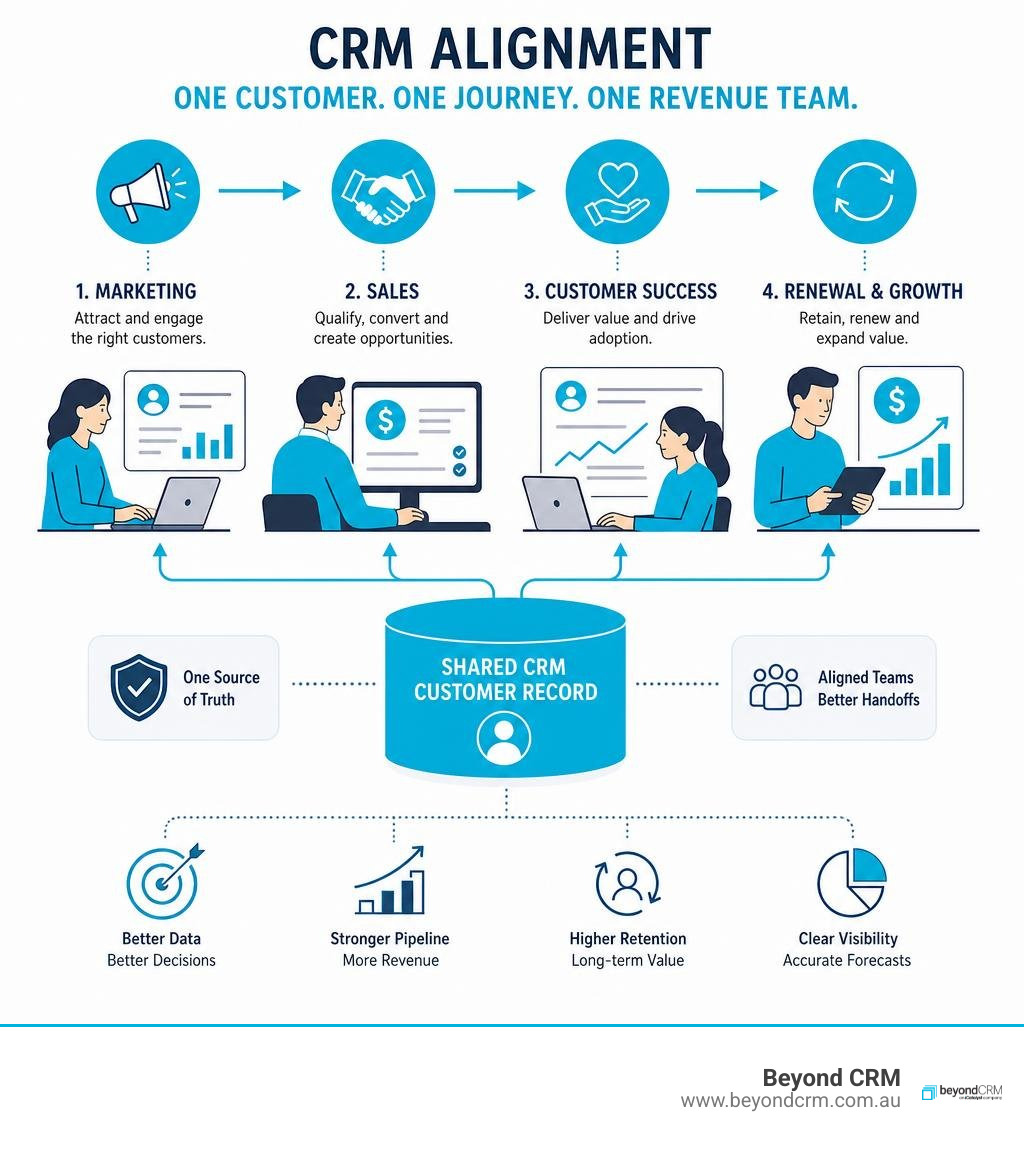
Why CRM Alignment Matters and What It Looks Like in Practice
CRM alignment matters because every customer interaction depends on information created by someone else. Marketing needs to know which leads sales accepted. Sales needs campaign history and account context before a conversation. Delivery and service teams need the commitments made during the sales process. When that context is missing, the customer has to repeat information and internal teams make decisions from incomplete records.
What Are the Signs of a Misaligned CRM?
Common signs include different definitions of a qualified lead, multiple versions of the same account record, opportunities that remain open long after activity has stopped, and service teams that cannot see key sales commitments. Other warning signs are frequent spreadsheet exports, disputed forecast figures, and customer handovers that rely on email rather than a defined workflow.
A misaligned CRM is not simply a data-cleaning problem. It usually means the business has not agreed on what each lifecycle stage means, who owns it, or which information must be captured before a record moves forward.
What Does CRM Alignment Look Like in Practice?
A practical aligned process is simple to describe. Marketing records the source and response history for a new contact. A lead becomes sales-ready only when it meets agreed criteria. Sales accepts or returns the lead with a recorded reason. When an opportunity closes, the delivery or service team receives the scope, stakeholders, risks, and next actions in the relevant account record.
For example, a consulting firm may require an opportunity owner to confirm the buying committee, commercial priorities, expected start date, and agreed scope before the deal can move to a final stage. The delivery manager then begins with a more complete brief rather than reconstructing the conversation from emails.
Research often cited by Gartner has estimated that poor data quality costs organisations an average of US$12.9 million each year. The exact financial impact varies by organisation, but the underlying lesson is clear: inconsistent customer information creates avoidable operational cost.

How to Align Sales and Marketing in a CRM
Sales and marketing alignment begins with a shared definition of a good lead. Both teams should agree on the information required before a lead is passed to sales, the time allowed for follow-up, and the reason codes used when a lead is not accepted. A CRM then makes those agreements visible and measurable.
Build Shared Lifecycle Stages and Handover Rules
Start by defining a small number of stages that match the real customer journey. For each stage, document four points:
- The entry criteria, including the information that must be known.
- The accountable owner.
- The next action and expected response time.
- The conditions that allow the record to move to the next stage.
For example, a marketing-qualified lead may need a verified business need, a relevant contact, and evidence of engagement. A sales-qualified lead may additionally require a confirmed conversation, a likely project timeframe, and a clear reason to pursue the opportunity. The important point is not the labels. It is that every team uses the same rules.
Create a Feedback Loop Instead of a One-Way Handover
Alignment weakens when marketing sends leads and never learns what happened next. Use structured outcome fields so sales can record whether a lead was accepted, disqualified, deferred, or returned for further nurturing. Marketing can then compare campaign activity with accepted opportunities and improve targeting without relying on anecdotal feedback.
Dynamics 365 can support these workflows with shared records, required fields, routing rules, and role-specific views where they are configured for the organisation. The platform should reinforce an agreed process rather than add unnecessary administration.
A useful next step is to unite business teams around one CRM so that process decisions, data stewardship, and reporting are built around the same customer journey.

CRM Integrations, Ownership, and Measurement
CRM alignment needs three things beyond a shared sales process: the right integrations, clear ownership, and a small set of useful measures. Adding more tools will not solve a process that has no agreed rules, but the right connections can reduce manual re-entry and give teams the context needed to serve customers well.
What Systems Should a CRM Integrate With?
The best integrations are those that provide information a team needs to take the next customer-facing action. Depending on the organisation, this may include marketing automation, customer service or case management, finance and billing, project delivery, document management, and business intelligence systems.
For example, service teams may need to see active contract information before prioritising a case, while account managers may need to see unresolved service issues before discussing a renewal. BeyondCRM can connect Dynamics 365 with systems already used across a client’s technology environment, working alongside internal IT teams and other solution providers. Integration choices should reflect the customer journey, security requirements, and the business value of the data being shared.
Who Owns CRM Alignment?
CRM alignment is a shared operating responsibility, not a task for one administrator. An executive sponsor resolves cross-team decisions. Revenue or operations leaders maintain lifecycle definitions and reporting standards. Sales, marketing, service, and delivery leaders own the quality of information their teams create and use.
A practical governance routine may include a monthly review of duplicate records, stalled opportunities, lead acceptance, handover delays, and recurring data problems. The team should then assign one owner and one deadline to each improvement, rather than treating data quality as a general concern.
How Do You Measure CRM Alignment?
Measure CRM alignment through behaviours and outcomes, not system logins alone. Useful measures include lead acceptance time, the share of records with required data completed, conversion between lifecycle stages, the number of duplicate accounts, opportunity ageing, forecast accuracy, customer handover completion, and retention indicators.
For instance, if sales accepts most qualified leads quickly but opportunities frequently stall after proposal, the problem may be stage design or sales execution rather than marketing quality. Regular measurement helps teams locate the break in the journey and improve the specific rule, handover, or integration involved.
For further practical guidance, BeyondCRM’s CRM process optimisation services explain how to turn agreed stages and governance into workable CRM processes.
CRM Alignment FAQs: Common Questions Answered
What is CRM alignment?
CRM alignment is the practice of coordinating sales, marketing, service, and operations around shared customer records, lifecycle stages, ownership rules, and performance measures. Its purpose is to give each team the information and accountability needed to move the customer journey forward without avoidable gaps.
Why is CRM alignment important?
CRM alignment helps organisations reduce duplicate records, missed handovers, inconsistent reporting, and conflicting customer communications. It also gives leaders a clearer view of pipeline health, customer risk, and where a process is breaking down.
How do you align sales and marketing in a CRM?
Agree on the definition of a qualified lead, the fields required before handover, the response expectation for sales, and the outcomes sales must record. Then use CRM workflows and reports to make the process visible. Review rejected or delayed leads together so both teams improve the criteria over time.
What systems should a CRM integrate with?
A CRM should integrate with systems that supply or need customer information for an important business decision or handover. Common examples include marketing automation, customer service, finance, project delivery, document management, and business intelligence. The right list depends on the organisation’s customer journey, existing systems, data controls, and operational priorities.
Who is responsible for CRM alignment?
Senior leaders should sponsor cross-team decisions, while operational leaders maintain the working rules. Sales, marketing, service, and delivery teams are each responsible for recording reliable information and following the agreed handover process. A CRM administrator can support configuration, but cannot create alignment without that shared accountability.
How long does CRM alignment take?
Early improvements, such as clarifying lead ownership and required fields, can be made quickly. Wider alignment involving integrations, data remediation, training, governance, and change management usually takes longer. A phased approach is often more effective than attempting to replace every process at once.
How do you measure CRM alignment?
Track the quality and speed of handovers as well as business results. Useful measures include lead acceptance time, required-field completion, duplicate-record rates, stage conversion, opportunity ageing, forecast accuracy, service context at handover, and retention indicators. Choose measures that help teams identify the specific rule or transition that needs attention.
Conclusion: Building Sustainable CRM Alignment
CRM alignment works when teams agree on the customer journey, the information required at each stage, and the person responsible for the next action. Start with clear lead and opportunity rules, connect the systems that genuinely support customer work, and measure where handovers slow down or lose context.
Microsoft Dynamics 365 can provide a practical foundation for these processes when it is designed around the organisation’s operating model and connected to the wider technology environment. The most valuable outcome is not a more complicated CRM. It is a clearer, more reliable way for teams to work with customer information.


