

CRM Challenges: Avoid Top 6 Project Failures
Understanding the Landscape of CRM Challenges
CRM challenges affect the vast majority of businesses attempting to implement or modernise their customer relationship management systems. Here’s what you need to know:
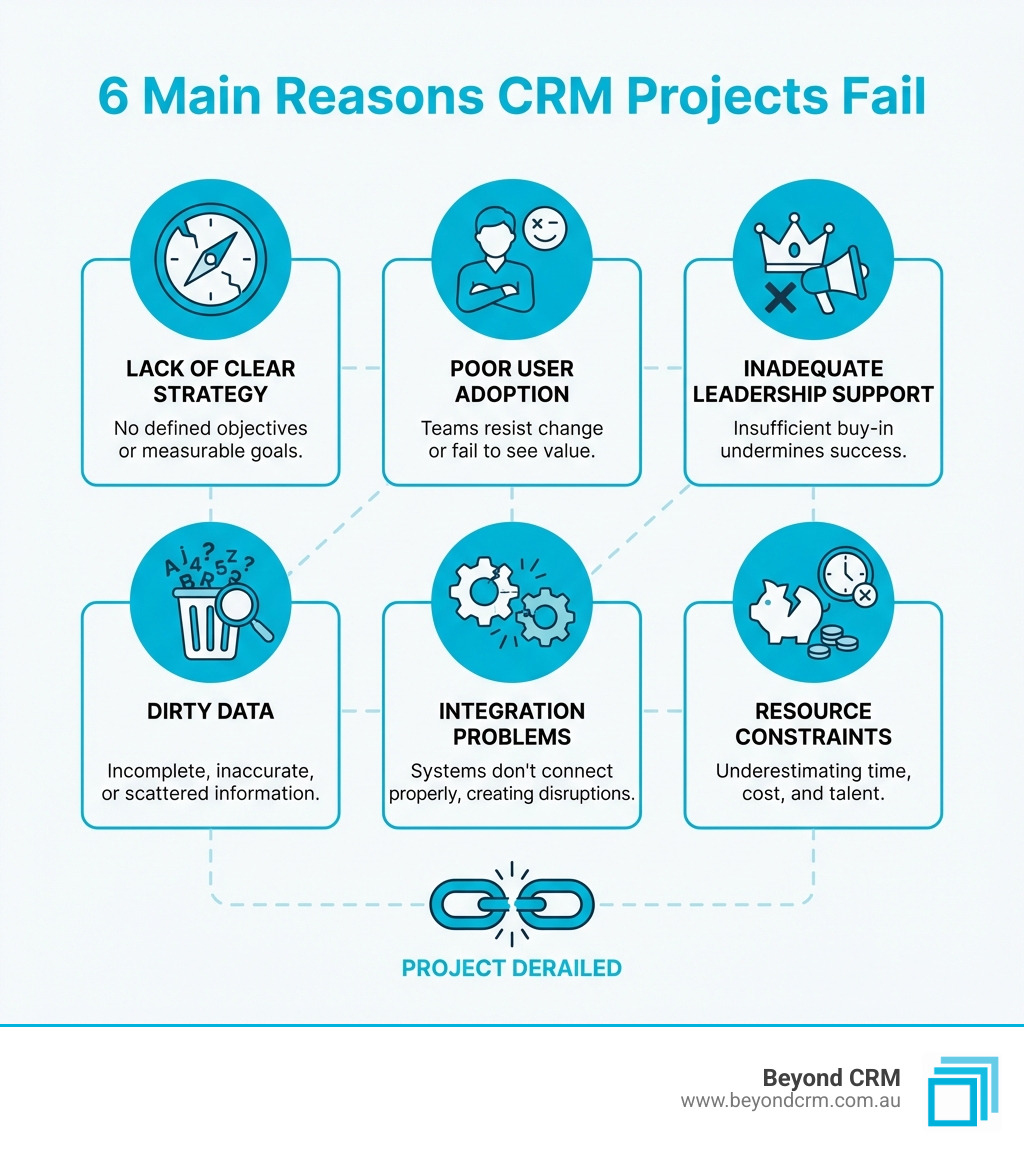
The Most Common CRM Challenges:
- Lack of clear strategy – Starting without defined objectives or measurable goals
- Poor user adoption – Teams resist change or fail to see the value for their daily work
- Inadequate leadership support – Insufficient buy-in from management undermines success
- Dirty data – Incomplete, inaccurate, or scattered information sabotages effectiveness
- Integration problems – Systems don’t connect properly, creating workflow disruptions
- Budget and resource constraints – Underestimating time, cost, and skilled talent requirements
The statistics paint a stark picture. Research suggests that up to 70% of CRM implementations may fail to meet expectations. That’s not because CRM technology doesn’t work—it’s because too many projects suffer from poor planning and flawed execution.
The issues are predictable. We’ve seen them again and again: businesses dive in without a clear roadmap, teams aren’t properly trained, leadership doesn’t champion the change, and data quality is overlooked until it’s too late. When these CRM challenges aren’t addressed upfront, organisations waste significant budget, lose productivity, and end up with frustrated staff and disappointed customers.
The good news? These problems are avoidable with the right approach.
I’m Warren Davies, and I’ve spent over 30 years navigating CRM challenges for businesses across Australia, from small enterprises to government agencies. At Beyond CRM, we’ve built our entire methodology around addressing these common pitfalls before they derail your project.
The Most Common CRM Challenges (And Why They Derail Projects)
Implementing a Customer Relationship Management (CRM) system promises a wealth of benefits: better customer insights, streamlined sales processes, and improved customer service. However, the path to a successful CRM can be fraught with problems. In fact, up to 70% of CRM implementations may not meet expectations, often leading to project failure, wasted budget, and lost productivity. As highlighted in the MIT Sloan Review, understanding “Why CRM Fails — and How to Fix It” is crucial for any organisation considering or undergoing a CRM project.
When a CRM project derails, the consequences ripple throughout the business. Not only does it mean a significant financial investment goes to waste, but it can also lead to decreased employee morale, a loss of critical customer insights, and a fragmented approach to customer engagement. This is why addressing the root causes of these CRM challenges head-on is paramount.
1. No Clear Strategy: One of the biggest CRM challenges
One of the most significant CRM challenges we encounter is the absence of a well-defined strategy. Many businesses start on a CRM implementation without a clear understanding of their objectives, a detailed roadmap, or measurable Key Performance Indicators (KPIs). This often stems from unclear business requirements and misaligned IT goals, creating a disconnect between what the business needs and what the technology delivers.
Without a strategic plan, a CRM project can quickly lose direction. How will the CRM support your customer retention goals? What specific sales processes will it streamline? How will you measure its success? Starting an implementation without answering these fundamental questions is like setting sail without a compass. It leads to confusion, scope creep, and ultimately, a system that doesn’t genuinely serve your business needs.
At Beyond CRM, we believe a robust strategy is the foundation of any successful CRM project. Our approach begins with a comprehensive CRM system analysis to define clear objectives, align with your broader business strategy, and establish a phased plan with achievable goals. This upfront work ensures that your CRM is built to deliver tangible value from day one. More info about our CRM system analysis services.
2. Poor User Adoption and Resistance to Change
Even the most technologically advanced CRM system is useless if your team doesn’t use it. Poor user adoption is a critical CRM challenge, often driven by a natural human resistance to change. Employees may fear the unknown, feel comfortable with existing processes, or worry about their job security. A common sentiment is, “What’s in it for me?” (WIIFM). If users perceive the CRM as a burden rather than a tool that simplifies their work, they will resist using it, undermining the entire investment.
Inadequate training is a frequently cited problem. If users don’t know how to steer the system, understand its features, or see how it benefits their daily tasks, they’ll revert to old habits or spreadsheets. This lack of intuitiveness and customisation know-how is a major frustration for executives, with 76% reporting it as a concern.
Overcoming resistance requires a proactive change management strategy. It’s about demonstrating the CRM’s value, providing hands-on training, and involving users in the process. We focus on making the CRM intuitive and relevant to each user’s role, ensuring they see how it makes their work easier and more efficient. See our Dynamics 365 adoption best practices.
3. Inadequate Leadership and Stakeholder Involvement
For any CRM project to truly succeed, it needs champions at every level, especially from leadership. Insufficient stakeholder involvement and a lack of leadership buy-in can cripple a project before it even starts. Without management’s full support and active participation, the CRM initiative can lose momentum, resource allocation may falter, and employees might not take the new system seriously.
Leadership plays a crucial role in communicating the CRM’s strategic importance, allocating necessary resources, and fostering a culture that accepts change. If leaders view the CRM as merely an IT project rather than a strategic business imperative, their teams will likely follow suit. Regular alignment meetings between IT, sales, marketing, and customer service are essential to ensure all departments are on board and their needs are met.
At Beyond CRM, we recognise that strong leadership and cross-functional collaboration are non-negotiable. We work closely with key stakeholders to ensure they understand the benefits, champion the implementation, and actively participate throughout the project lifecycle. This creates a unified vision and internal support critical for successful adoption and long-term success.

4. The “Dirty Data” Dilemma: Quality and Migration Issues
Imagine building a beautiful house on a shaky foundation. That’s what happens when you implement a CRM system with poor data quality. Incomplete, inaccurate, or disparate data is a pervasive CRM challenge that can severely undermine the system’s effectiveness and lead to significant business losses. A recent survey found that 24% of CRM administrators reported less than half of their data as correct and complete, and a staggering 31% stated that poor data quality costs them at least 20% of their business’s revenue.
“Dirty data” includes duplicate entries, outdated contact information, inconsistent formatting, and missing critical details. When your CRM is populated with such data, it provides unreliable insights, hampers targeted marketing efforts, and frustrates sales and service teams. Users quickly lose trust in a system that provides flawed information, further exacerbating adoption problems.
Data migration, the process of transferring existing data into the new CRM, is another critical aspect. If not handled carefully, it can introduce errors, lose historical context, or disrupt business operations. Our data migration expertise ensures data integrity and compliance, minimising disruption and providing a clean, accurate foundation for your new CRM. Learn about our data migration services.
5. Technical Tangles: Integration, Customisation, and Other CRM Challenges
The modern business landscape relies on interconnected systems. When a new CRM fails to integrate seamlessly with existing technologies, it creates significant workflow disruptions – a common technical CRM challenge. This can lead to manual data entry, siloed information, and a fragmented view of the customer. It’s no wonder that 54% of United States operations report integration with their existing tech stack as their biggest benefit to using CRM tools.
Customisation, while powerful, can also be a double-edged sword. Tailoring a CRM to fit unique business processes can improve efficiency, but excessive or poorly managed customisation can lead to “technical debt.” This debt manifests as systems that are difficult to maintain, upgrade, or integrate with future technologies. It can also be a source of frustration, with 76% of executives citing customisation know-how as a key challenge. Scope creep, where project requirements continuously expand, further complicates customisation efforts, leading to budget overruns and delayed timelines.
Choosing the right CRM that is scalable and aligns with your growth trajectory is also vital. A system that works for a small team today might buckle under the pressure of a growing enterprise tomorrow. We help businesses steer these technical complexities by prioritising configuration over custom code and ensuring that any customisation serves a clear business purpose, avoiding unnecessary complexity and technical debt. Explore our Dynamics 365 integration services.
6. Resource Constraints: Budget, Time, and Talent
Even with the best intentions, CRM challenges can arise from practical limitations related to resources. Budget limitations are a common hurdle; updating a CRM program requires significant financial investment, not just for the software itself, but also for training, process revisions, and change management. Many organisations underestimate these ongoing costs.
Time is another precious resource. CRM implementation is not a “set it and forget it” project; it demands dedicated time from various departments, from initial planning to ongoing optimisation. Delays can lead to increased costs and frustrated teams.
Furthermore, a skilled talent shortage can significantly affect CRM modernisation efforts. Businesses need personnel with expertise in planning, execution, operations, and ongoing expansion. Without the right in-house skills, organisations may struggle to fully leverage their CRM’s capabilities or address issues as they arise. This often necessitates looking for external expertise. Insufficient security and compliance planning also pose risks, as CRMs house sensitive customer data, making them targets for cyber threats. Robust security measures, such as automated threat detection and access control, are crucial to protect against data breaches.

How Beyond CRM Does It Differently: A Blueprint for Success
At Beyond CRM, we understand these common CRM challenges because we’ve helped countless Australian businesses steer them. Our approach is built on a foundation of over 30 years of experience, specialising in Microsoft Dynamics 365. We don’t just implement software; we partner with you to create a blueprint for success, ensuring your CRM delivers real, measurable value.
Our expert-led approach and proven methodology are designed to mitigate risks, streamline processes, and empower your team. We focus on proactive planning, meticulous execution, and continuous support, ensuring your Dynamics 365 solution is not just a tool, but a strategic asset that grows with your business.
Expert Planning & Scoping
We start by eliminating the “no clear strategy” challenge from the outset. Our process begins with an in-depth assessment of your current business processes, existing systems, and unique requirements. This isn’t a one-size-fits-all approach; we tailor our findy phase to truly understand what success looks like for your organisation.
We collaborate with your key stakeholders to define clear objectives, identify potential risks, and build a strategic roadmap that aligns your CRM with your broader business goals. This meticulous planning and scoping phase ensures there are no surprises down the line, giving you a clear path forward and a Dynamics 365 solution that’s precisely matched to your needs. Our CRM Kickstart package is a great example of how we provide a fixed-price, fixed-scope solution for rapid deployment, addressing this upfront. Learn about our CRM Kickstart package.
Data Migration & Integration Expertise
“Dirty data” is a problem we tackle head-on. Our data migration expertise is a cornerstone of our service, ensuring data integrity, compliance, and minimal disruption to your operations. We conduct thorough data audits, cleanse existing records, and implement phased data migration strategies to ensure a smooth transition of your valuable customer information into Dynamics 365.
Furthermore, we specialise in overcoming integration challenges. We perform comprehensive system audits to identify all existing technologies that need to connect with your CRM. Whether it’s integrating with your finance systems or connecting with other Microsoft 365 applications, we ensure seamless connections that eliminate manual data entry and provide a unified view of your customer. Our goal is to make your Dynamics 365 solution the central hub of your customer data, accessible and actionable across all relevant platforms. Secure your CRM data migration.
A Focus on User Adoption
We know that poor user adoption can sink even the best CRM. That’s why our approach is deeply rooted in empowering your team. We don’t just implement software; we ensure your employees accept and excel with Dynamics 365. Our strategy includes hands-on, role-specific training sessions custom to how your team actually works. We provide clear communication about the benefits of the CRM, answering the “What’s in it for me?” for every user.
We help identify and empower internal CRM champions who can advocate for the system and support their colleagues. We also configure custom dashboards and simplified workflows that make the CRM intuitive and directly relevant to each role, reducing friction and increasing efficiency. This focus on user experience transforms the CRM from a burden into an invaluable tool, driving higher adoption rates and greater productivity. Boost your CRM adoption rates.
Balanced Customisation
Customisation can be a powerful asset, but it needs to be managed wisely to avoid technical debt and complexity. Our philosophy at Beyond CRM is to adopt an “out-of-the-box” (OOTB) first approach. This means we leverage the robust standard features of Dynamics 365 wherever possible, configuring the system to match your unique business processes rather than immediately resorting to custom code.
When customisation is necessary, we approach it strategically. We preserve critical workflows that differentiate your business while ensuring that any bespoke development is scalable, maintainable, and doesn’t hinder future upgrades. This balanced approach ensures your Dynamics 365 solution is custom to your needs without creating unnecessary complexity or technical debt, making it a future-proof solution that can evolve with your business. Discover our CRM customisation services.
Ongoing Support & Optimisation
Our partnership doesn’t end at implementation. We understand that a CRM is a living system that needs to evolve with your business. That’s why we offer comprehensive post-implementation support and optimisation services. We provide continuous improvement, ensuring your Dynamics 365 solution remains aligned with your changing business needs and takes advantage of new features and functionalities.
We offer flexible support models, ranging from ad hoc assistance for specific queries to custom monthly assistance packages. This ensures that you always have access to expert guidance, whether you need help with minor tweaks, performance tuning, or strategic advice for future improvements. Our goal is to ensure your CRM investment continues to deliver maximum value, empowering your team and enhancing your customer relationships long after the initial rollout. Explore our specialist support options.
FAQs
What is the main reason CRM projects fail?
The main reasons CRM projects fail often stem from a combination of factors, including a lack of clear strategy and defined objectives, poor user adoption due to inadequate training or perceived burden, bad data quality, and insufficient leadership support. These issues collectively hinder the CRM from aligning with and supporting specific business goals.
How do you ensure good user adoption for a new CRM?
Ensuring good user adoption for a new CRM involves several key strategies: securing executive sponsorship, involving users in the planning process, providing custom and hands-on training, simplifying workflows, customising dashboards to be role-relevant, and clearly communicating the benefits for each team member’s daily tasks. Continuous support and feedback loops are also crucial.
Is it better to customise a CRM or use it out-of-the-box?
The best approach is a balanced one. We recommend starting with out-of-the-box (OOTB) features of Dynamics 365 first, then configuring the system to match your processes. Custom development should only be considered sparingly for unique, high-value requirements that cannot be met through configuration, as this helps avoid unnecessary complexity and technical debt.
Ready to Avoid CRM Project Failure?
Navigating the complex landscape of CRM challenges doesn’t have to be a daunting task. With the right expert guidance and a structured approach, your CRM project can move beyond common pitfalls and achieve its full potential. We’ve seen how a well-implemented Dynamics 365 solution can transform businesses, driving efficiency, improving customer relationships, and delivering real, measurable value.
At Beyond CRM, we’re committed to ensuring your Dynamics CRM project is a resounding success from day one. Our deep expertise with Microsoft Dynamics 365, combined with our proven methodology for planning, implementation, and ongoing support, means you can confidently invest in a CRM that truly works for your business in Brisbane, Queensland, and across Australia.
Don’t let predictable CRM challenges derail your investment. Contact BeyondCRM today to ensure your Dynamics CRM project succeeds from day one.


